Quick Answer:
Speech therapy should start as soon as you notice consistent delays in your child’s talking, not after waiting it out. Early speech therapy helps late talkers build communication skills faster by targeting understanding, sounds, and interaction in everyday routines. The right support focuses on what your child needs now, not just their age.
What does it actually mean when a child is a late talker?
If your child understands you but uses very few words or no words at all, they may be considered a late talker. Many late talkers are between 18 months and 3 years old and are not meeting typical speech milestones for their age.
This does not automatically mean something is “wrong.” Some children catch up on their own. The problem is that parents are often told to wait and see, and waiting can delay help that makes a real difference.
Late talking can look like:
- Using fewer than 20 words by age 2
- Not combining words by age 2.5 to 3
- Relying on gestures instead of speech
- Becoming frustrated when trying to communicate
Speech therapy helps identify whether your child simply needs a boost or whether there is an underlying speech or language difficulty that needs support.
When should you start speech therapy for a late talker?
The short answer is earlier than most parents are told.
If your child is:
- 18 months and not using meaningful words
- 2 years and not combining words
- 3 years and hard to understand or speaking very little
Speech therapy should start now.
Research consistently shows that early speech therapy leads to better long-term outcomes. The American Speech-Language-Hearing Association explains that early intervention improves communication, learning, and social development outcomes for children with speech delays.
Waiting until preschool or school age often means:
- More frustration for your child
- Harder habits to change
- Slower progress
Starting early does not label your child. It gives them tools.
What actually helps late talkers in speech therapy?
This is where parents need clarity, not generic advice.
Effective speech therapy for late talkers focuses on:
- Understanding language before producing words
- Increasing motivation to communicate
- Building speech sounds in functional ways
- Teaching parents how to support speech at home
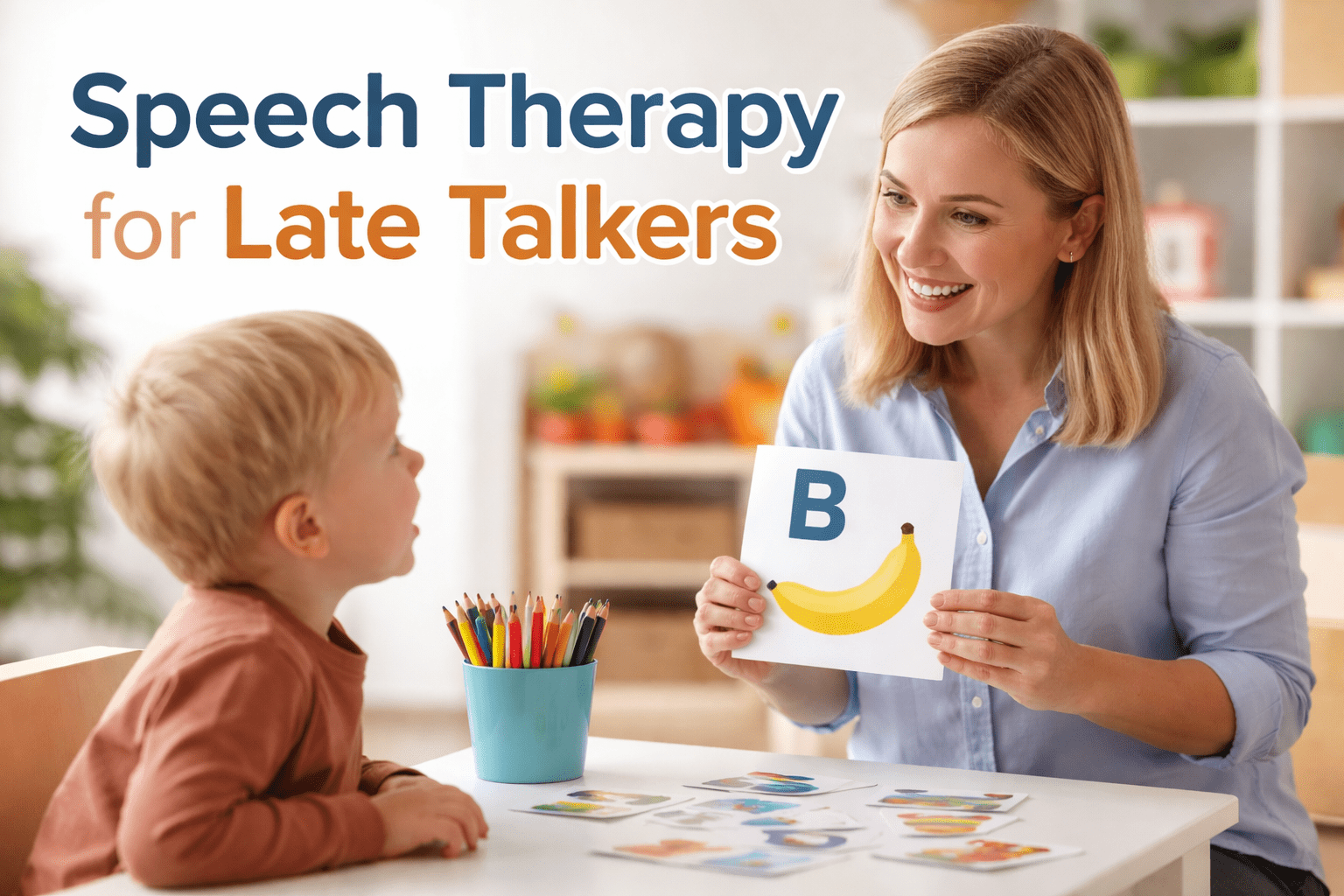
At Advantage Therapy, speech therapy is play-based, child-led, and practical. Your child is not drilled or pressured. Therapy happens through activities that feel natural and meaningful.
What really helps:
- Repetition in everyday routines
- Visual supports and gestures
- Modeling simple words and phrases
- Following your child’s interests
Speech therapy works best when it extends beyond the session into daily life.
Is speech therapy different for toddlers versus preschoolers?
Yes, and this matters.
For toddlers, speech therapy focuses heavily on:
- Joint attention and interaction
- Understanding words and instructions
- Early sounds and gestures
- Turn-taking and play skills
For preschoolers, therapy may also include:
- Expanding sentence length
- Improving clarity of speech
- Developing social communication skills
The goal is always functional communication, not just ticking milestone boxes.
Can speech therapy help if my child also has sensory or regulation challenges?
Absolutely, and this is often overlooked.
Many late talkers also have sensory sensitivities, difficulty with attention, or emotional regulation challenges. These can directly impact speech development.
This is where collaboration with Occupational Therapy becomes powerful. Speech Therapy and Occupational Therapy often work together to support communication, sensory processing, and participation in daily activities.
If your child benefits from Occupational Therapy support, you can learn more through the Occupational Therapy service at Advantage Therapy. Understanding your child’s sensory needs through a neurodiversity-affirming approach helps speech therapy be more effective and respectful.
What can parents do at home that actually supports speech?
Parents make the biggest difference.
Simple strategies that help late talkers:
- Talk less and model more
- Use short, clear phrases
- Follow your child’s lead in play
- Pause to give them time to respond
- Celebrate all communication attempts
Avoid pressuring your child to “say it properly.” Communication grows best in a calm, supportive environment.
Speech therapists guide parents on how to embed these strategies into daily routines like meals, bath time, and play.
How long does speech therapy take for late talkers?
This depends on your child, not a fixed timeline.
Some children make rapid progress in a few months. Others need ongoing support. What matters is consistent therapy, parent involvement, and addressing the right foundations.
Progress looks like:
- More attempts to communicate
- Reduced frustration
- Increased word use or sound variety
- Better understanding of language
Speech therapy is not about rushing outcomes. It is about building communication that lasts.
Do late talkers always catch up without speech therapy?
Some do. Many do not.
The risk of waiting is missing the window where intervention is most effective. Speech therapy does not harm children who might have caught up anyway. Delaying support can harm children who need it.
Speech therapy is not a last resort. It is early support.
Where can families access speech therapy support locally?
Advantage Therapy supports families across Norwest, The Hills Shire Council, and the wider Hills District, with additional services available in Sydney CBD. Speech Therapy is delivered with a calm, respectful, and neurodiversity-affirming approach that values your child as they are.
If you are exploring funding options or additional support, the DIR model and related developmental frameworks can also play a role in supporting communication and relationships alongside therapy.
What should you do next if you are concerned?
Trust your instincts.
If you are asking whether speech therapy might help your late talker, that question matters. Early support can reduce stress for both you and your child.
Speech therapy is not about pushing children to talk. It is about giving them the tools, confidence, and support to communicate in ways that work for them.
If you want to understand how Speech Therapy could support your child, start with a conversation with us.