
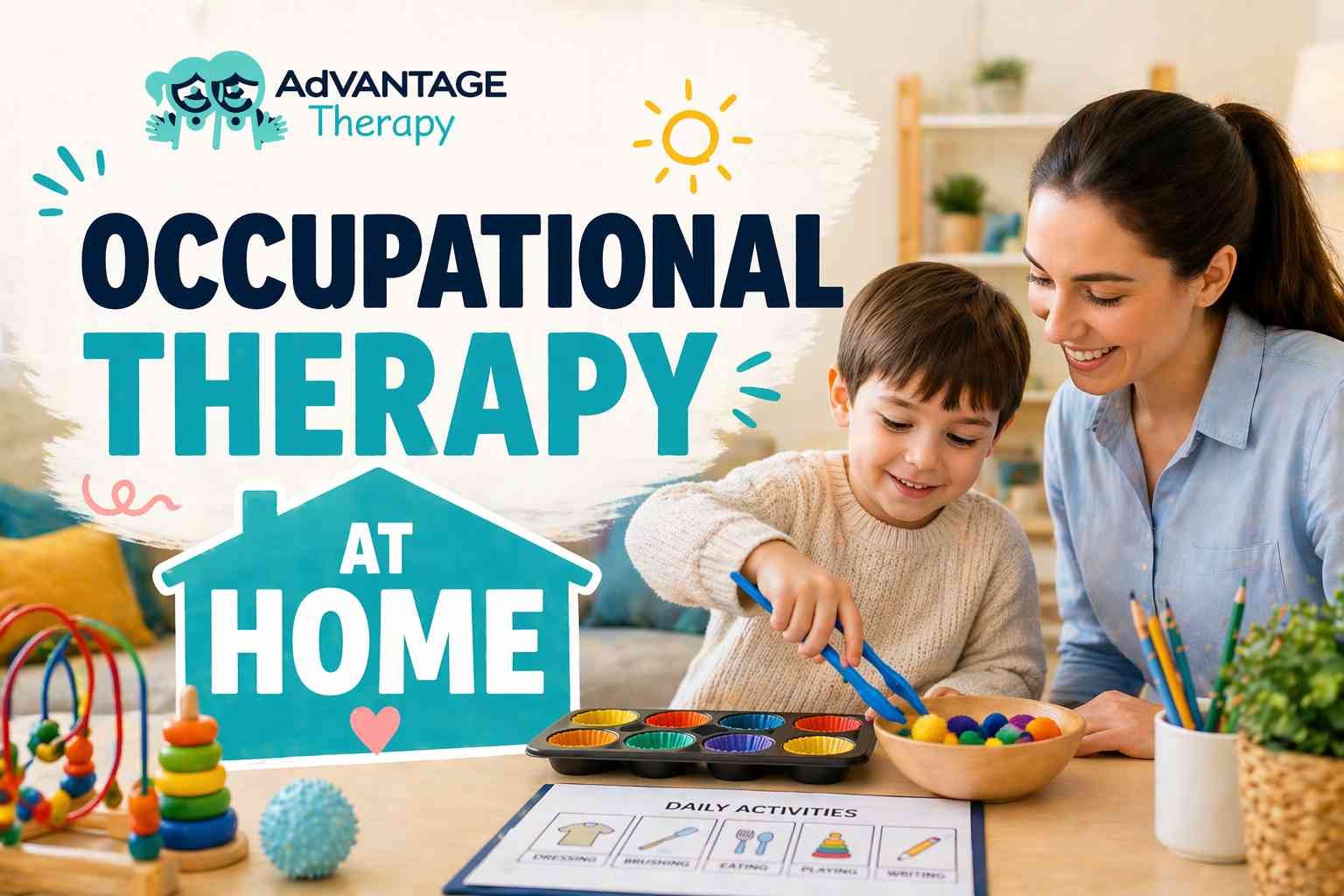
If your child struggles with focus, meltdowns, or everyday tasks like getting dressed, occupational therapy at home isn’t complicated — it’s practical, structured support built into your child’s daily routine.
At Advantage Therapy, we help you turn ordinary moments into opportunities for growth. You don’t need expensive equipment or hours of free time. You need the right strategies — applied consistently.
This guide shows you exactly what that looks like.
What Is Occupational Therapy at Home?
Occupational therapy at home means using everyday activities to build your child’s skills — where they naturally live, play, and learn.
Instead of relying only on clinic sessions, you:
- Reinforce therapy goals during real-life routines
- Use your home environment as a learning space
- Support your child in moments that actually matter
For kids aged 2–12, especially those with sensory processing or attention challenges, this approach works because it’s consistent and relevant.
You’re not “doing therapy sessions.”
You’re upgrading how daily life works for your child.
Why Occupational Therapy at Home Works (Especially in Sydney Homes)
Here’s the reality: your child’s biggest challenges don’t happen in a clinic — they happen at home.
Think about:
- Morning routines before school
- Mealtime struggles
- Transitions (screen time → bedtime)
- Emotional outbursts after a long day
That’s why occupational therapy for kids at home delivers better carryover.
In areas like Norwest and across Western Sydney, families are increasingly choosing:
- Home-based strategies
- Parent-led implementation
- Support from therapists who understand real-life environments
This is also where mobile occupational therapy Sydney services add value — therapists can assess your actual setup, not a staged clinic environment.
What Occupational Therapy Looks Like in Daily Life
Let’s make this real.
Here’s what home occupational therapy activities actually look like — no fluff.
Morning Routine (Dressing + Transitions)
- Lay out clothes in sequence (underwear → shirt → pants)
- Use visual schedules (simple picture cards)
- Practice “first–then” language: First shirt, then breakfast
👉 Builds: independence, sequencing, reduced resistance
Mealtime (Feeding + Sensory Tolerance)
- Offer different textures gradually (soft → mixed → crunchy)
- Let your child help prepare food (mixing, pouring)
- Use smaller portions to avoid overwhelm
👉 Builds: oral motor skills, flexibility, confidence
Play Time (Fine Motor + Focus)
- Lego, puzzles, drawing, cutting activities
- Obstacle courses using cushions or furniture
- Timed play sessions (5–10 min focus blocks)
👉 Builds: attention span, coordination, problem-solving
Emotional Regulation Moments
- Create a “calm-down corner” (beanbag, weighted toy, soft lighting)
- Teach simple breathing: smell the flower, blow the candle
- Use movement breaks (jumping, pushing, pulling)
👉 Builds: self-regulation, emotional control
Evening Routine (Wind Down + Sleep Prep)
- Consistent sequence: bath → pyjamas → quiet activity → bed
- Reduce stimulation (dim lights, no screens)
- Use predictable cues (same story, same time)
👉 Builds: routine stability, better sleep patterns
A Real Parent Scenario (What Changes Over Time)
One parent in The Hills District came to us overwhelmed.
Her 5-year-old:
- Refused to get dressed
- Had daily meltdowns before school
- Couldn’t sit through meals
We didn’t “fix” it in a clinic.
We adjusted her home routine:
- Simplified clothing choices
- Introduced a visual morning chart
- Added short movement breaks before transitions
Within weeks:
- Dressing time dropped from 30 minutes to 10
- Meltdowns reduced significantly
- Mealtimes became manageable
This is how occupational therapy at home works — small changes, applied consistently.
Do You Need Professional Support or Can You Do It Alone?
Here’s the honest answer: you can start on your own, but most parents hit a wall.
Why?
Because:
- Every child’s sensory profile is different
- Trial-and-error wastes time
- Incorrect strategies can make behaviours worse
That’s where working with a clinic like Advantage Therapy helps.
We don’t just give advice — we:
- Assess your child’s specific challenges
- Design personalised home strategies
- Coach you on implementation
- Adjust based on progress
If you’ve searched “occupational therapy near me”, what you actually need is not proximity — it’s relevance to your child’s daily life.
How to Start Occupational Therapy at Home (Simple Plan)
Don’t overcomplicate this. Start here:
- Pick one routine (morning OR bedtime — not both)
- Identify one struggle (e.g., dressing resistance)
- Apply one strategy consistently for 7–10 days
- Track small wins (less resistance, faster completion)
Consistency beats intensity.
FAQs
What is occupational therapy at home?
It’s using everyday activities — like dressing, eating, and playing — to build your child’s skills in their natural environment.
Can I do occupational therapy at home without a therapist?
Yes, you can start with basic strategies. But for faster and more targeted progress, professional guidance is recommended.
What are simple sensory activities for kids at home?
Jumping, pushing heavy objects, playing with textured materials, and obstacle courses are effective sensory activities that improve regulation.
Is mobile occupational therapy available in Sydney?
Yes. Many providers, including Advantage Therapy, offer support that aligns with your home environment and daily routines.
Ready to Make Daily Life Easier?
If your child struggles with routines, focus, or emotional regulation, waiting won’t fix it — structure will.
At Advantage Therapy, we help you turn your home into a place where your child can succeed daily — not just during therapy sessions.
Book a consultation today and get a clear, practical plan tailored to your child.